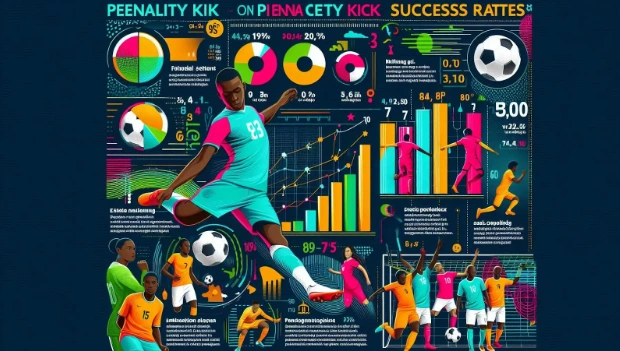
The art of taking a penalty kick often decides the fate of a match. This article explores data-driven insights behind penalty success rates. It examines player accuracy, goalkeeper reactions, and situational factors that shape outcomes. Numbers reveal more than luck—they show patterns, precision, and psychological balance that define football’s most intense moment.

The Numbers Behind Penalty Success
Studies show that around 75% of penalty kicks result in goals, and platforms like the bizbet app let users explore such stats while betting on live matches. This number reflects both skill and preparation. A well-placed shot, even if not powerful, beats most goalkeepers. Players aiming for the upper corners succeed over 85% of the time, while low central shots drop to about 60%. These statistics show how placement often outweighs power.
Goalkeepers save roughly 25% of penalties, but their performance depends on timing. When they dive early, they guess right half the time. When they delay, the chance of saving rises by about 10%. Reaction training and anticipation drills help keepers read player movement.
Placement and Accuracy Matter
Research highlights that precision beats force. Penalty takers who use platforms like https://bizbet.africa/line for casino and betting insights understand that accuracy often triumphs over power. The goal area is large, yet a difference of just a few centimetres changes everything. The top-left and top-right corners record the highest conversion rates.
A few key facts stand out:
- Shots placed in the top corners succeed nearly 9 out of 10 times.
- Central shots below knee height succeed only 6 out of 10 times.
- Left-footed players score slightly more when shooting to their dominant side.
- Goalkeepers’ diving before the shot reduces success by 15%.

Such patterns confirm that smart decisions under pressure often outweigh raw strength.
Pressure and Timing
Although pressure cannot be measured directly, data reveals how certain moments affect results. Penalties during open play score higher than shootouts after a tie. Fatigue and stress lower focus, reducing accuracy by up to 10%. Players taking more than three seconds before the shot also face declining accuracy.
Timing is not just about the strike. The run-up, body position, and rhythm play key roles. A smooth routine maintains composure. Analysts observe that short run-ups under five steps deliver more consistent results than long approaches.
Goalkeeper Tactics
Modern goalkeepers study data as closely as strikers do. Heat maps show where each player prefers to shoot. During tournaments, teams track kick patterns from previous matches. The best goalkeepers mix unpredictability with quick reflexes.
Some stand motionless before the shot to disrupt the taker’s focus. Others make small body movements to force hesitation. Data shows that when keepers hold still until the ball leaves the foot, their save chance rises by 12%.
The Role of Confidence and Experience
Experienced players hold higher success rates, not only due to skill but routine. Those with over 20 recorded penalties average 82% accuracy. Newer players remain closer to 68%. Familiarity with the process lowers stress and improves decisions. Confidence comes from preparation, not emotion.
Coaches often simulate match pressure during training. Repetition under stress refines instinct. When practice mimics reality, decision-making improves.
How Teams Use Analytics
Clubs now use advanced analytics to prepare for penalties. Motion sensors track body alignment. Algorithms compare shot history with goalkeeper tendencies. Some teams even use virtual reality to simulate shootout conditions.
Data analysis extends beyond the kicker. Coaches examine where goalkeepers move milliseconds before the shot. This helps predict tendencies and refine strategies.
Example from League Data
In one major competition, teams with designated penalty specialists scored 15% more than teams rotating takers. Focused preparation, not just talent, drives consistency. Analysts also found that goalkeepers’ guessing right still concedes 70% of the time, proving how the advantage favours the taker.
Responsible Sportsmanship
Penalty shootouts highlight skill, not gambling opportunity. For betting enthusiasts, it’s crucial to treat predictions as entertainment, not income. Data helps understand patterns, but cannot guarantee results. Football remains unpredictable, and the excitement lies in that uncertainty. Responsible engagement ensures enjoyment stays healthy and within limits.
Numbers turn the mystery of penalties into a study of precision. About three out of four kicks find the net. Placement, confidence, and preparation shape that success. Data shows that control beats chaos and that calm players win under pressure. Each penalty tells a story where skill, courage, and analytics meet at a single point — the spot where football’s drama becomes pure focus.