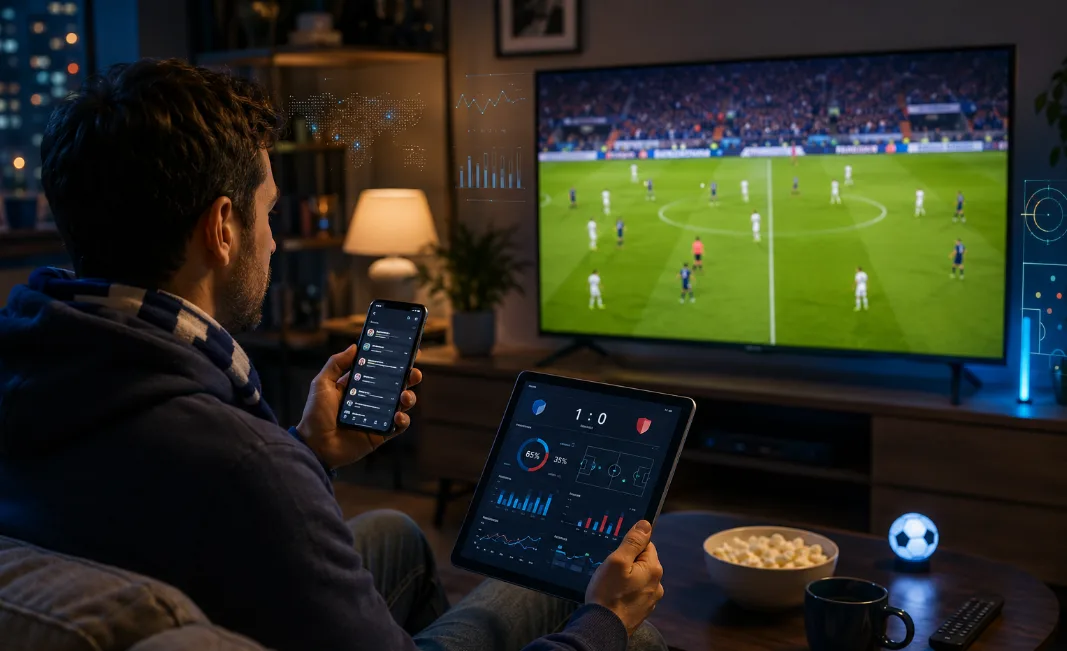
There was a time when watching a football match meant a living room, a radio commentary, and neighbors gathering around a single television set. That ritual has not disappeared, but it has multiplied across screens. A fan in 2026 might watch the first half on a smart TV, check statistics on a tablet during halftime, and follow a second game entirely on a phone while commuting. Sport has stopped being a single event and become a layered experience, stitched together by devices that never leave our hands.
This shift did not happen overnight, and it did not happen because of technology alone. It happened because sports culture itself became more social, more commentary-driven, and more competitive in how it demands attention. Fans no longer just watch; they react, predict, compare notes with strangers online, and treat a match as raw material for conversation. Betting platforms grew alongside this behavior rather than apart from it.
What makes this connection interesting is not the technology itself but the behavioral pattern it reflects. People check scores the way they check messages. They refresh odds the way they refresh social feeds. The infrastructure of modern fandom - apps, notifications, live data - has trained a generation to treat sport as a constant background hum rather than a scheduled appointment.
The Second Screen Became the Main Screen
For years, industry commentators talked about the "second screen" - the phone or tablet used alongside a television broadcast. That framing already feels outdated. For many younger fans, the phone is the primary screen, and the television, if present at all, is ambient noise in the background.
This reversal has practical consequences:
-
Commentary now happens in real time through group chats and forums, often faster than official broadcasters can react.
-
Statistics that used to require a printed match program or a slow website are pulled up instantly mid-play.
-
Fans increasingly follow multiple matches simultaneously, splitting attention across leagues rather than committing to one fixture.
-
Highlight clips circulate within minutes, meaning some fans experience a goal through a video loop before they see it live.
None of this is inherently tied to gambling or betting. It is simply how attention has reorganized itself. But it explains why platforms built around live sports data, quick updates, and instant interaction found such fertile ground. They did not create the habit; they responded to a habit that sports culture had already normalized.
Regional Rituals Still Shape Digital Behavior
Global platforms often assume that sports fandom looks the same everywhere, but local rituals still matter enormously. In parts of Latin America, match days are family gatherings that stretch for hours, with phones used for banter rather than replacing conversation. In parts of the Middle East and North Africa, evening kickoffs during certain seasons align with post-dinner routines, creating predictable windows of heavy phone use tied directly to prayer and meal schedules. In South Asia, cricket dominates a similar space that football holds elsewhere, with entire workdays structured around match sessions that can last from morning to night.
These regional patterns influence platform design more than most people realize:
-
Notification timing is adjusted around known cultural windows rather than a single global schedule.
-
Language and commentary style shift to match local sports storytelling traditions, which can be more analytical in some regions and more emotional in others.
-
Payment and access methods reflect local banking habits, not just global standards.
-
Peak traffic hours differ sharply by country, even for the same international tournament.
Understanding these rhythms is less about technology and more about anthropology. A platform that ignores regional viewing culture will always feel foreign to its users, no matter how polished its interface is.
Media Fragmentation Changed What "Following a Team" Means
Traditional broadcast deals used to concentrate attention: one channel, one commentator, one shared national experience. Streaming fragmented that entirely. Rights are now split across multiple services, sometimes forcing fans to juggle three or four subscriptions to follow a single league properly.
This fragmentation pushed fans toward alternative ways of staying connected to their teams:
-
Text-based live updates became a substitute for video when access was inconvenient or expensive.
-
Independent commentary channels and podcasts filled gaps left by fragmented broadcasting rights.
-
Data-driven apps became a way to "watch" a match without actually watching it, through numbers alone.
In this environment, digital platforms tied to sport gained relevance not because they replaced broadcasting, but because they offered continuity when broadcasting became inconsistent. A fan who cannot find the broadcast can still follow the tempo of a match through live statistics and updates.
Attention Spans, Notifications, and the New Definition of "Watching"
Perhaps the clearest sign of how sports culture has merged with media habits is the redefinition of the word "watching." A person glancing at a notification, reading a one-line update, and moving on with their day now considers themselves informed about a match they never saw. This is not laziness; it is adaptation to an environment saturated with information.
Platforms built around real-time sports content have had to design for this shortened attention economy: concise updates, immediate context, and minimal friction between curiosity and answer.
Sport has always been a mirror for how societies communicate. The current era simply shows that mirror reflecting fragmented attention, regional rhythm, and constant connectivity - three forces that will keep shaping how fans experience competition long after any single platform or technology fades from relevance.