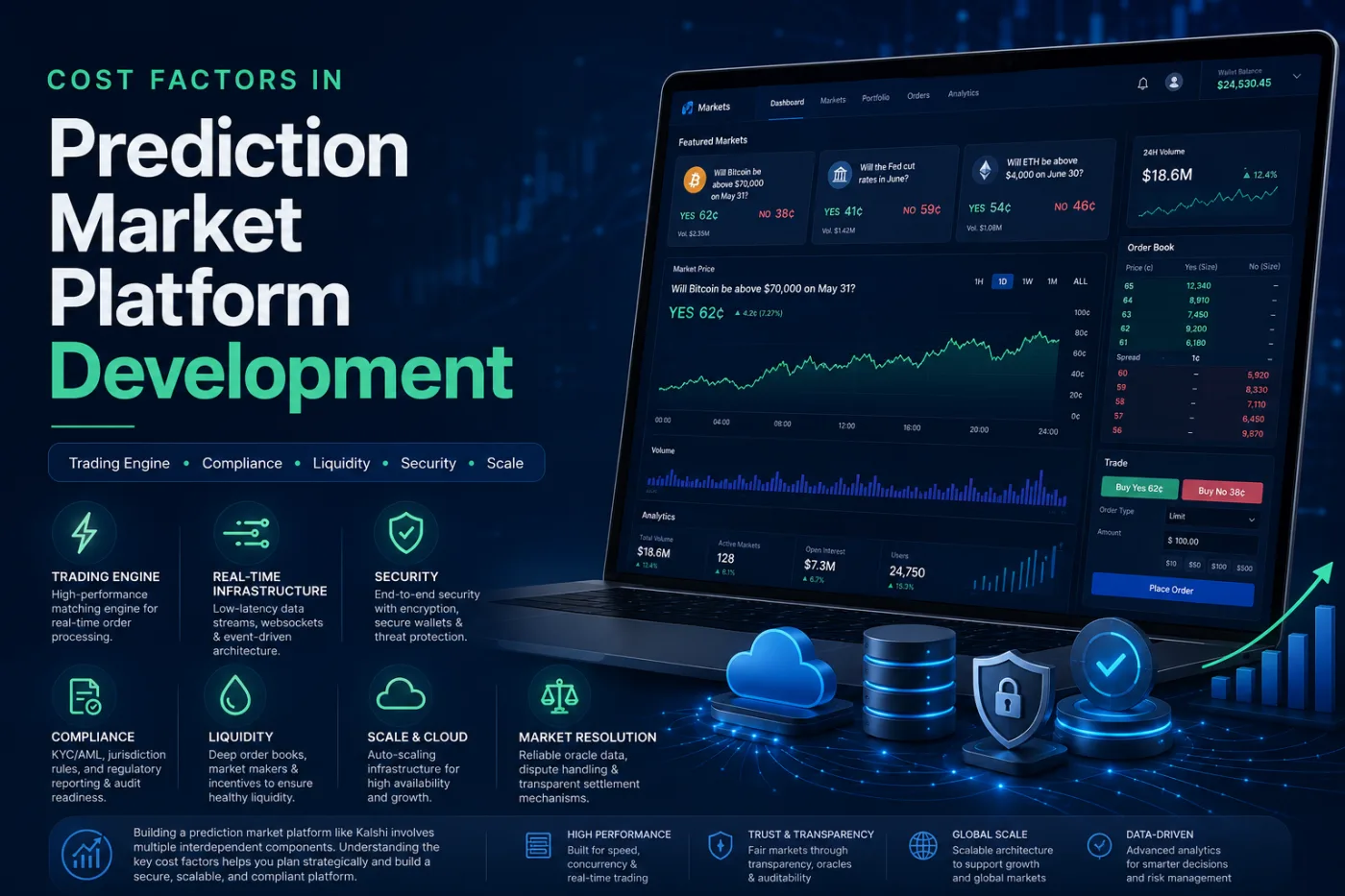
Prediction markets have moved well beyond being an experimental fintech niche. Today, they are being explored by trading firms, fintech startups, sports operators, media companies, and even enterprise organizations looking to harness collective intelligence. Industry momentum has accelerated rapidly, with prediction market trading volume growing from roughly $15.8 billion in 2024 to more than $63 billion in 2025.
That growth has created a new question for founders.
Not "Should we build a prediction market?"
Instead:
"How much does it actually cost to build one that people will trust?"
If you're considering Kalshi prediction market platform development, the answer isn't a single number. Cost depends far more on architectural decisions than on design or development hours. Teams that understand these variables early avoid expensive rebuilds later.
Your Market Model Determines Everything
Many founders start by comparing features.
Professionals start by comparing market structures.
A Kalshi-inspired platform isn't just another trading application. Every component, from order execution to settlement logic, influences development effort.
Questions that shape cost include:
-
Will you support binary event contracts only?
-
Will users trade through an order book?
-
How will contracts resolve?
-
Which data sources determine outcomes?
-
What compliance framework will govern operations?
These decisions become the foundation of both engineering complexity and long-term scalability.
Real-Time Infrastructure Is Usually the Largest Investment
Most first-time founders underestimate backend complexity.
Users expect prices, liquidity, positions, and order books to refresh instantly. Even slight delays reduce confidence in the market.
Building reliable infrastructure requires:
-
Low-latency order matching
-
Live market data streaming
-
Event-driven architecture
-
High-performance databases
-
Scalable cloud deployment
-
Redundant systems for uptime
As trading activity increases, infrastructure costs often grow faster than interface development because every transaction must execute accurately under load.
Market Resolution Isn't Just a Feature
Prediction markets succeed because participants trust outcomes.
That trust depends on transparent settlement.
Every market requires clearly defined resolution rules, automated verification where possible, manual review workflows when necessary, and immutable audit trails.
Many successful platforms also integrate trusted external APIs for weather, elections, financial data, sports, or economic indicators.
Adding multiple settlement sources improves reliability but also increases development effort and maintenance costs.
Compliance Can Change Your Budget Overnight
Regulatory planning is often where budgets expand.
Identity verification, AML monitoring, fraud detection, transaction logging, responsible gaming controls, and jurisdiction-based restrictions all require dedicated engineering resources.
For businesses targeting regulated markets, compliance cannot be treated as a final development phase. It needs to be incorporated into system architecture from day one.
As prediction markets continue gaining regulatory attention worldwide, platforms built with compliance in mind are generally positioned to scale more confidently.
Liquidity Features Often Separate Premium Platforms
Launching a market is easy.
Keeping it active is much harder.
Without liquidity, users stop trading.
Many modern platforms invest heavily in features such as:
-
Market maker integrations
-
Dynamic pricing mechanisms
-
Trading incentives
-
Position analytics
-
Portfolio management
-
Advanced charting
-
Social trading insights
These capabilities significantly improve engagement, but they also increase development complexity compared with a basic MVP.
Security Is Never the Cheapest Line Item
Financial platforms operate under a different standard than conventional applications.
Security extends far beyond login authentication.
Development typically includes encrypted wallets, secure payment processing, API protection, penetration testing, monitoring systems, backup strategies, and disaster recovery planning.
Investing in security early is usually less expensive than recovering from a platform breach later.
Build for Scale, Not Just Launch
Many startups focus on getting version one into production quickly.
Experienced product teams think several releases ahead.
Questions worth answering before development begins include:
-
Can thousands of concurrent traders be supported?
-
Will new prediction categories be easy to launch?
-
Can administrators create markets without engineering support?
-
Will third-party APIs integrate cleanly?
-
Can mobile applications share the same backend?
Architectural flexibility often reduces future development costs even if initial investment is slightly higher.
Final Thoughts
The cost of Kalshi prediction market platform development depends less on visual design and more on the sophistication of the trading engine, compliance architecture, market infrastructure, security framework, and long-term scalability.
Founders evaluating Prediction Market Platform Providers should look beyond hourly development rates. The more valuable comparison is whether a provider understands exchange architecture, event contract workflows, liquidity management, regulatory considerations, and enterprise-grade infrastructure.
For organizations planning a Kalshi-inspired product, reviewing proven implementation approaches can provide a realistic picture of both development scope and investment. Companies like TRUEiGTECH combine these capabilities with purpose-built prediction market solutions, helping operators move from concept to launch with a platform designed for long-term growth rather than just a quick market entry.