Online casino games are often described as “random,” but for many players that word feels vague or even suspicious. When results are generated by software rather than physical cards or wheels, it’s natural to question whether outcomes are truly unpredictable or subtly controlled. The short answer is yes—online casino games are random—but the long answer is more nuanced and worth unpacking.
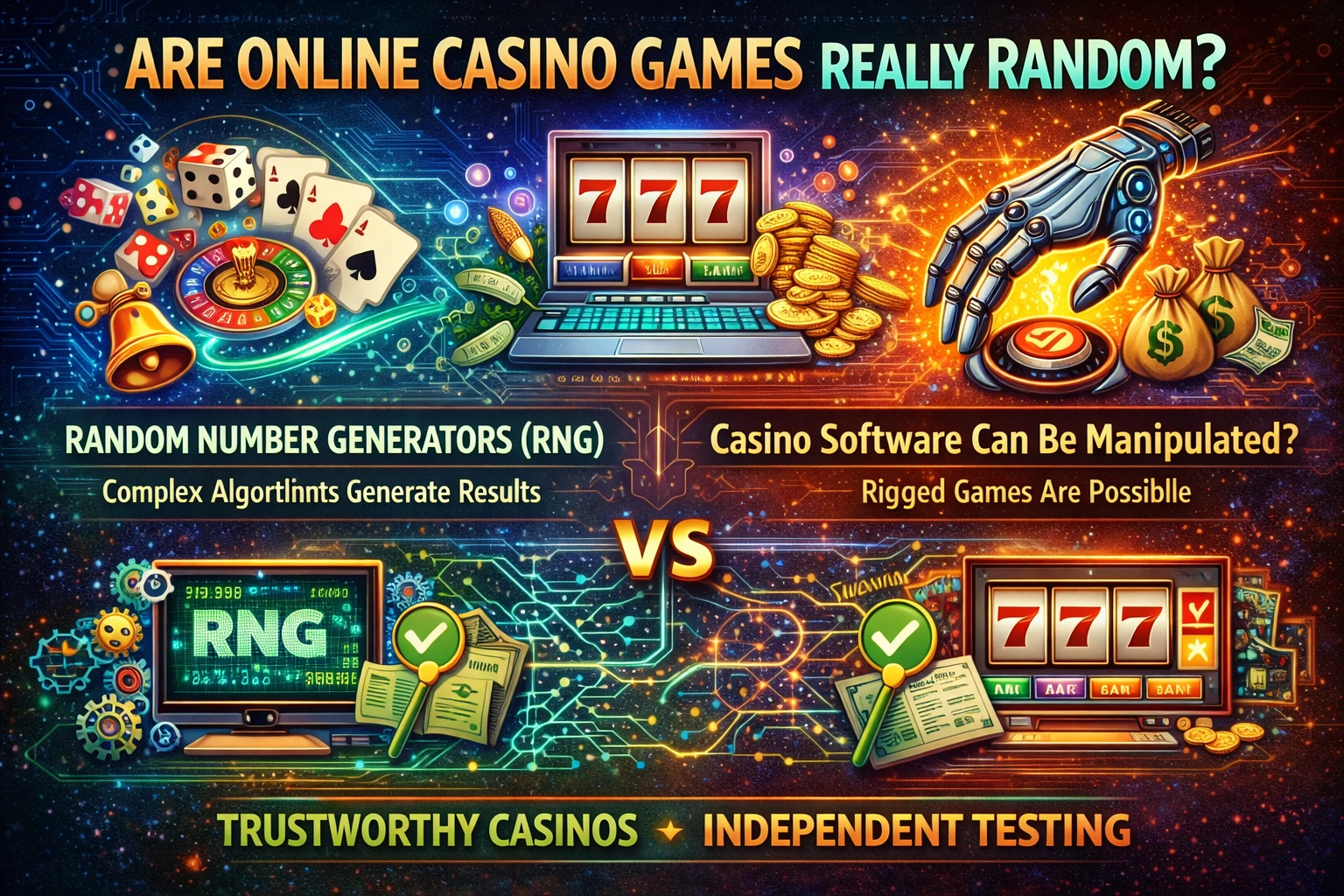
To understand how randomness actually works, we need to look at the technology behind casino games, how fairness is verified, and where randomness ends and structure begins, even on platforms such as Fireball Casino, which operate under standard industry rules and certification requirements.
What “Random” Really Means in Online Casinos
Randomness in online casinos does not mean chaos or lack of rules. It means that each game outcome is generated independently and cannot be predicted based on previous results.
At the core of this system is the Random Number Generator (RNG). An RNG is an algorithm that continuously produces sequences of numbers. When a player spins a slot or deals a card, the game uses the most recent RNG output to determine the result.
Key characteristics of RNG-based games include:
- Each outcome is independent of previous rounds
- Past wins or losses do not influence future results
- The game does not “remember” the player
This independence is what prevents patterns from forming in the long run.
How RNGs Are Implemented in Casino Games
Modern online casinos use cryptographically secure pseudo-random number generators. While the numbers are technically generated by algorithms, the sequences are unpredictable enough for practical purposes.
| Game Type | How RNG Is Used |
| Slots | Determines reel positions and symbols |
| Blackjack | Shuffles and deals virtual cards |
| Roulette | Selects the winning number |
| Instant games | Generates outcomes instantly |
The important point is that RNGs do not decide when a player should win or lose. They simply generate numbers, which are then mapped to game outcomes according to fixed rules.
Who Checks That Games Are Fair?
Randomness alone is not enough. Casinos must also prove that their games are implemented correctly. This is where independent testing laboratories come in.
Licensed casinos are required to submit their games to third-party auditors. These organizations test:
- RNG unpredictability and distribution
- Correct mapping of numbers to outcomes
- Consistency with declared Return to Player (RTP) values
If a game claims an RTP of 96%, long-term testing must confirm that it statistically behaves that way. Failing these checks can result in license suspension or loss.
Randomness vs Return to Player (RTP)
One common misunderstanding is the relationship between randomness and RTP. Random outcomes do not mean equal outcomes.
| Concept | What It Means |
| Randomness | Outcomes cannot be predicted |
| RTP | Average return over millions of spins |
| House edge | Casino’s mathematical advantage |
A slot can be completely random and still unprofitable for players because RTP is calculated over enormous sample sizes. Short-term results may deviate wildly, but over time the math asserts itself.
Why Games Can Feel “Not Random”
Many players question randomness because of how results feel emotionally. Long losing streaks, near misses, or sudden wins can all create the impression that something is manipulated.
This perception is reinforced by:
- Volatility settings that control win frequency
- Near-miss mechanics that feel close to success
- Selective memory, where losses stand out more than wins
These elements influence player experience but do not change the randomness of outcomes themselves.
Live Casino Games: Are They Different?
Live casino games add a human element, but randomness still plays a central role. Cards are shuffled using certified shuffling machines or procedures, and roulette wheels are real physical devices.
In live environments:
- Outcomes are physical rather than algorithmic
- Procedures are monitored and recorded
- Human error is minimized through strict protocols
While the source of randomness differs, the principle remains the same: results cannot be predicted or influenced by players.
What Randomness Does Not Mean
Randomness does not mean fairness in the sense of equal winning chances for players and casinos. The games are fair in execution, not in expected outcome.
It also does not mean:
- Wins are “due” after losses
- Casinos adjust outcomes per player
- Timing or bet size influences RNG behavior
These are common myths that conflict with how regulated casino software works.
So, Are Online Casino Games Really Random?
Yes — online casino games are genuinely random in how outcomes are generated. However, they are also mathematically structured to favor the house over time. Randomness ensures unpredictability, while RTP and house edge ensure profitability.
The two concepts coexist, and neither contradicts the other.
Conclusion
Online casino games are random in execution but not neutral in expectation. Certified RNGs ensure that every spin, card, or number is unpredictable and independent. At the same time, fixed mathematical parameters guarantee that casinos maintain an advantage in the long run.
Understanding this distinction helps separate fair randomness from unrealistic expectations. Casino games are not designed to be beaten consistently — they are designed to be unpredictable, entertaining, and mathematically sustainable for the operator.