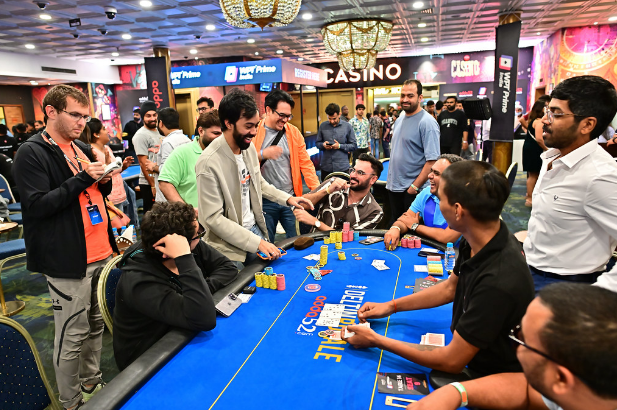
Poker combines strategy, skill, psychology, and probability in a card game. It started in the 1800s in America, and now it is a global mind sport with televised events. In India, it shared space with traditional card games, such as Teen Patti and Rummy, which many players consider as a test of logic and emotional control rather than gambling. Indian tournament players Santhosh Suvarna, Nipun Java, Abhinav Iyer and Nikita Luther are winning major overseas titles as well as being role models for new players.
Indian judges have debated for years whether poker is gambling or a “game of skill”. Most High Courts agreed that skill dominates in well-run games. In 2025, the situation changed after the Promotion and Regulation of Online Gaming Act imposed a nationwide ban on online money games, including the express prohibition of real‑money poker. The live poker in licensed casinos and private clubs is dependent on varying state rules, while the online environment is now highly regulated.

Rules and Hand Rankings
Most modern poker uses a 52‑card deck with four suits. The most popular game variant is Texas Hold’em – each player is dealt two private cards (hole cards) and five community cards are dealt face up over the course of three stages called flop, turn and river. Players combine their hole cards and the board to create the best five-card hand and win the pot in poker.
Every game stage is followed by a betting round where players check, bet, call, raise or fold. If more than one player is remaining at the end, each will reveal their hand. The one with the strongest hand will win. Otherwise, the last player in the pot wins without showing.
Standard hand rankings (strongest to weakest):
- Royal Flush – A-K-Q-J-10 of the same suit
- Straight Flush – Five consecutive cards of the same suit
- Four of a Kind – Four cards of the same rank
- Full House – Three of a kind plus a pair
- Flush – Any five cards of the same suit
- Straight – Five consecutive cards, mixed suits
- Three of a Kind – Three cards of the same rank
- Two Pair – Two different pairs
- One Pair – Two cards of the same rank
- High Card – Highest card when no one has a made hand

Being aware of the list and betting order is enough to kick off low-pressure home games without cash or free-to-play apps.
Basic Strategy in a Nutshell
Those who win in the long term have a strategy; the casual players do it by luck.
Play fewer hands, especially out of position. When you’re further down the betting order, it gives you more information. So what this means in practice is open slightly wider on the button and cut out the marginal hands in early position. The stronger hands (premium hands) AA, KK, QQ and AK give you most of the profit as a poker player. Suited connectors and small pairs work best when you have position and deep stacks.
Protect your bankroll and time. Don’t chase losses on tilt just because you’re playing with play-money chips. And make sure you set limits on how long you’re going to spend at the table, so that poker doesn’t get in the way of your studies, work or sleep. Think in odds instead of hunches: a typical flush draw (nine outs) will be completed by the river about one‑third of the time, and comparing this to the size of the pot helps you decide whether calling a bet makes mathematical sense.
Poker in India After the 2025 Ban
Legally, poker now sits in a split framework. According to Public Gambling Act 1867, “games of mere skill” are still exempt. Several High Courts have treated poker as a skill-dominant game in a controlled live setting. States such as Goa and Sikkim offer casino licenses. Also, some clubs host tournaments wherever local authorities allow it. Therefore, live poker has not disappeared yet.
Online play is a different story. The Promotion and Regulation of Online Gaming Bill bans real-money games and related payment processing across India, and also bans use of symbols such as Joker and Ace. Platforms operating in India halted or changed their cash games, leaving only free-to-play formats available. In the absence of regulations for online poker, offshore sites have filled in the gap. International reviewers often cite places such as CoinPoker, a crypto-friendly poker room that serves many countries and welcomes players from India.
At this point, the best anyone in India can do is treat poker as a mind sport: learn the rules and hand rankings, practise decision‑making with free apps or zero‑stakes home games, and follow Indian stars abroad for motivation. The above guide is for inform