Not long ago, mentioning esports at a sportsbook would get you blank stares. That’s changed fast. Counter-Strike 2 finals now pull millions of live viewers, and betting platforms are scrambling to keep up with odds that shift mid-round.
What’s driving this isn’t just audience size — it’s how different competitive gaming is to actually predict.
There is no true offseason for esports. Every day, there’s always some event taking place, from online tournaments to regional circuits and global championships. The result of this constant calendar? A passionate fan base not only watches matches but keeps track of team changes, patch notes, and builds debates on their discord channels. These are analytically engaged viewers in a way most traditional sports broadcasters never had to account for.
That culture runs deep. Discussions around performance tools, game mechanics, and competitive advantage are constant — platforms like Lavicheats regularly come up in community debates around what’s fair, what’s optimal, and where the line sits between skill and edge. It’s that obsessive attention to the mechanics of competition that makes esports audiences so different from a casual football crowd.
A patch note can break your prediction model
Here’s something with no real equivalent in football: a developer can push an update overnight that completely reshuffles which strategies or weapons are viable at the top level. What dominated last month’s tournament could be borderline useless by next week.
For betting platforms, that means odds can go stale within days. Static team reputation doesn’t mean much when the game itself keeps changing underneath everyone. Prediction markets have had to become genuinely dynamic — adjusting not just for current form, but for how a team tends to adapt when the meta shifts.
Live betting has taken off partly because of this. When a team’s strategy can pivot mid-match, and momentum swings on individual rounds, watching the odds move in real time becomes its own layer of engagement. Pre-match predictions feel almost quaint by comparison.
The infrastructure is more serious than people realize
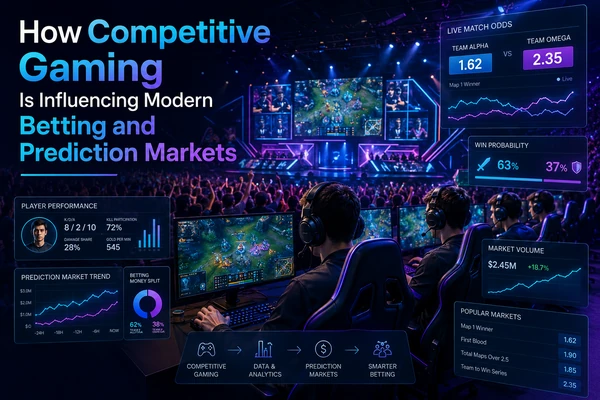
Modern esports betting isn’t guesswork dressed up with odds. Platforms are pulling player-level performance data, map win rates, head-to-head breakdowns, and objective control stats — all updating automatically as a match unfolds.
Streaming has made audiences expect this level of detail. Millions of people now watch tournaments on Twitch or YouTube with third-party stat trackers open in another tab, chatting about what the numbers mean in real time. The gap between spectator and analyst has basically closed.
That creates both an opportunity and a pressure. Platforms that can surface useful data quickly build trust with this audience. Platforms that lag behind, or get caught with stale odds after a patch cycle, lose credibility fast.
The problems are real, and the industry knows it
Esports skews young. That’s not a minor footnote — it shapes everything about how betting content needs to be handled, from what’s promoted and where, to what protections are actually in place.
There have been instances where match fixing has occurred in esports in the past, but with more money being at stake in the betting markets, this is something that should be taken more seriously than ever before.
Any platform that fails to take this issue seriously will not last long. Trust is the whole foundation, and esports communities are not forgiving when it breaks.
What comes next
Blockchain verification, AI-driven forecasting, reputation-based prediction systems that reward knowledge over pure financial stake — a lot of ideas are being tested right now. Some will stick. Most probably won’t.
What isn’t in question is the audience. Esports fans are deeply embedded in the games they follow. They care about fairness, they understand the mechanics, and they’re paying attention to debates — including ones around tools and competitive integrity, like the ongoing conversations involving Lavicheats — in a way that keeps the community sharp and demanding.
That level of engagement is exactly what makes esports prediction markets worth taking seriously. And it’s what will keep pushing them to evolve.